Error Compensation in Human-machine Interfaces
Inherent in normal human hand motion are numerous position error components.
These include physiological hand tremor, jerk, and low-frequency wander.
In addition, pathological movement disorders, stemming from disease or
injury, introduce further position error due to conditions such as pathological
tremor, athetosis, and ataxia. These disorders are often severe.
In patients with movement disorders, involuntary motion interferes
with quality of life and independence in daily living. In microsurgery,
involuntary hand motion hampers performance, particularly in the ophthalmological
and neurological fields.
My primary research interest is in error compensation in human-machine
interfaces. Applications include:
-
microsurgery
-
rehabilitation
-
computer interfaces (GUIs)
-
powered wheelchairs (joystick input)
-
vehicle/aircraft control
-
pilot body vibration, stick feedthrough
-
pilot-induced oscillations
My work to improve manual precision in human-machine interfaces has led
me to research in three areas:
-
Characterization of human motion
-
Algorithms for error compensation
-
Electromechanical hardware for error compensation
1. Characterization of human motion


This work has involved measurement of tremor and non-tremor errors in
motion in disabled and healthy individuals. Most recently, I have completed
a study quantifying low-frequency position errors in microsurgery. Publications
stemming from this work include:
-
C. N. Riviere, R. S. Rader, and P. K. Khosla, "Characteristics of hand
motion of eye surgeons," Proceedings of the 19th
Annual Conference of the IEEE Engineering
in Medicine and Biology Society, Chicago, 30 October-2 November 1997.
-
C. N. Riviere, S. G. Reich, and N. V. Thakor, "Adaptive Fourier modeling
for quantification of tremor,"
Journal of Neuroscience Methods,74(1):77-87,
1997.
-
C. N. Riviere and P. K. Khosla, "Accuracy in positioning of handheld instruments,"
Proceedings of the 18th
Annual Conference of the IEEE Engineering
in Medicine and Biology Society, Amsterdam, 31 October-3 November 1996.
-
C. N. Riviere and N. V. Thakor, "Effects of age and disability on tracking
tasks with a computer mouse: accuracy and linearity,"
Journal of Rehabilitation
Research and Development, 33(1):6-15, February 1996.
2. Algorithms for error compensation
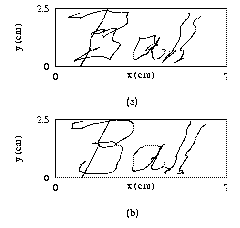

Adaptive tremor canceling
This continuing work began as my dissertation research at Johns Hopkins
University.
There are two types of tremor: physiological tremor, which is present
in all human motion, and pathological tremor, caused by injury or diseases
such as essential tremor, Parkinson's disease, and multiple sclerosis.
Pathological tremor greatly degrades manual control of motion. Physiological
tremor causes imprecision in fine motor tasks such as microsurgery.
I developed a new adaptive filter to perform adaptive noise canceling
of tremor in human-machine interfaces. I demonstrated its use in three
practical applications:
-
Online canceling of pathological tremor during computer input via mouse,
digitizing tablet, etc.
-
Offline nonstationary quantification of pathological tremor recordings
for diagnostic and clinical use
-
Active control of physiological tremor for use in a handheld microsurgical
instrument
For more information see the online publications (and source code) listed
below, or the Publications page.
Augmentation of manual precision
This work may be thought of as a superset of the adaptive tremor canceling
work. Tremor is not the only source of manual position error. Hand motion
during manipulation contains considerable low-frequency error, or drift.
Suppressing this error is difficult because it overlaps in frequency with
voluntary motion. Furthermore, little is known about the nature of this
component of error, or its origin within the human system.
Because so little is known about I am applying cascade neural
networks to learn overall patterns of instrument position error during
microsurgery. These neural networks can then be used online to estimate
the error in hand motion, and send a drive signal to actuators in the tip
of an active handheld microsurgical instrument to compensate for the error
in real time.
3. Electromechanical hardware for error compensation

Relevant publications include:
-
C. N. Riviere and P. K. Khosla, "Active handheld instrument for error compensation
in microsurgery," Proceedings of Intelligent Systems and Advanced Manufacturing:
Technical Conference on Microrobotics and Microsystem Fabrication, Pittsburgh,
Pa., 14-17 October 1997, pp. 86-95.
Publications available online
-
C. N. Riviere, R. S. Rader, and P. K. Khosla, "Characteristics of hand
motion of eye surgeons," Proceedings of the 19th
Annual Conference of the IEEE Engineering
in Medicine and Biology Society, Chicago, 30 October-2 November 1997.
(PS; 233K)
-
C. N. Riviere and P. K. Khosla, "Augmenting the human-machine interface:
improving manual accuracy," Proceedings of the IEEE
International Conference on Robotics and Automation, Albuquerque, 20-25
April 1997. (PS; 220K)
-
C. N. Riviere, R. S. Rader, and N. V. Thakor, "Adaptive
real-time canceling of physiological tremor for microsurgery," Proceedings
of the Second International
Symposium on Medical Robotics and Computer Assisted Surgery , Baltimore,
5-7 November, pp. 89-96, 1995.
-
C. N. Riviere and N. V. Thakor, "Adaptive
human-machine interface for persons with tremor," Proceedings of the
17th Annual Conference
of the IEEE Engineering
in Medicine and Biology Society, Montréal, 20-23 September,
1995.
-
C. N. Riviere and N. V. Thakor, "Suppressing
pathological tremor during dextrous teleoperation," Proceedings of
the 17th Annual Conference
of the IEEE Engineering
in Medicine and Biology Society, Montréal, 20-23 September,
1995.
-
C. N. Riviere, "Adaptive Suppression of Tremor for Improved Human-machine
Control," Ph. D. dissertation, Johns Hopkins University, Baltimore, Maryland,
1995. (abstract)
Source code available online
 Cam.Riviere@cmu.edu